

Market
Tailor made solutions for customers and create more innovative products for them
Document Source:DENSON (Dongguan Tisen New Material Co., Ltd.)
UV‑curable coatings feature ultra‑fast cross‑linking, near‑zero‑VOC emissions and high production efficiency, widely applied in electronics, plastics, wood, and decorative materials. Nevertheless, formulators and end‑users continuously face technical bottlenecks in formulation development, curing execution, colored‑system performance and long‑term film stability. This paper summarizes major industry pain points and corresponding technical countermeasures, including practical suggestions for pigment‑colorant systems.
| Pain Points | Root Causes | Technical Solutions |
|---|---|---|
| Oxygen‑inhibited surface tackiness after curing | Free radicals are quenched by atmospheric oxygen; especially obvious in thin‑film applications | 1. Apply amine‑based oxygen scavengers; 2. Increase UV energy density; 3. Adopt nitrogen‑inert curing environment; 4. Select surface‑cure‑oriented photoinitiator combinations |
| Insufficient depth‑of‑cure for thick or pigmented films | Pigment absorbs / scatters UV photons; wavelength mismatch between photoinitiator and light source | 1. Deploy long‑wavelength photoinitiators (TPO‑L, BAPO); 2. Optimize pigment loading and dry film thickness; 3. Use multi‑band UV‑LED light sources |
| Post‑curing yellowing risk | Photoinitiator photolysis fragments; oxidation of amine synergists; excessive irradiation energy | 1. Adopt low‑yellowing photoinitiator packages; 2. Reduce aromatic‑amine additives; 3. Control cumulative UV exposure dose; 4. Introduce UV‑absorber / HALS stabilizer system |
| High curing shrinkage, poor substrate adhesion | Volume shrinkage (2‑7%) from acrylate polymerization generates inner film stress | 1. Raise oligomer proportion, lower high‑shrinkage monofunctional monomers; 2. Apply corona / plasma substrate pre‑treatment; 3. Introduce dual‑cure resin components to release curing stress |
| Short shelf‑life of ready‑mixed UV formulations | Ambient light triggers premature free‑radical polymerization | 1. Add appropriate thermal‑/light‑stabilizing inhibitors; 2. Store finished materials under dark and low‑temperature conditions; 3. Separate color paste and base resin for on‑site tinting |
| Pain Points | Root Causes | Technical Solutions |
|---|---|---|
| Unstable curing performance caused by equipment aging | UV lamp energy decays after long‑time operation; spectrum drifting of LED modules | 1. Regularly monitor energy density by UV radiometer; 2. Replace aged lamps on schedule; 3. Match light‑source spectrum with photoinitiator absorption peak |
| Poor curing effect on complex 3‑D parts / shadow zones | Light cannot reach recessed geometric positions | 1. Adopt dual‑cure resin with secondary moisture‑curing mechanism; 2. Optimize multi‑angle light‑arrangement of curing equipment |
| Residual odor and migration risk of cured coating | Unreacted small‑molecule monomers and photoinitiator fragments remain in cross‑linked network | 1. Improve curing conversion rate by optimizing process parameters; 2. Select macromolecular / low‑migration photoinitiators; 3. Reduce residual reactive diluent monomers |
| High upfront investment for UV production lines | High cost of UV lamps, LED modules and safety enclosures | 1. Evaluate LED‑UV upgrade for medium‑and‑small‑batch production; 2. Optimize line speed to improve equipment utilization; 3. Phase‑by‑phase transformation of existing production lines |
Colored UV coatings bring extra technical challenges compared with clear formulations. Pigment particles absorb and scatter UV photons, which easily leads to incomplete curing, uneven tinting strength, pigment flocculation, gloss loss and batch‑to‑batch color deviation during storage and application. Conventional solvent‑based color pastes cannot be directly incorporated into 100%‑solid UV systems, which may induce incompatibility, surface defects and deterioration of mechanical properties of final films.
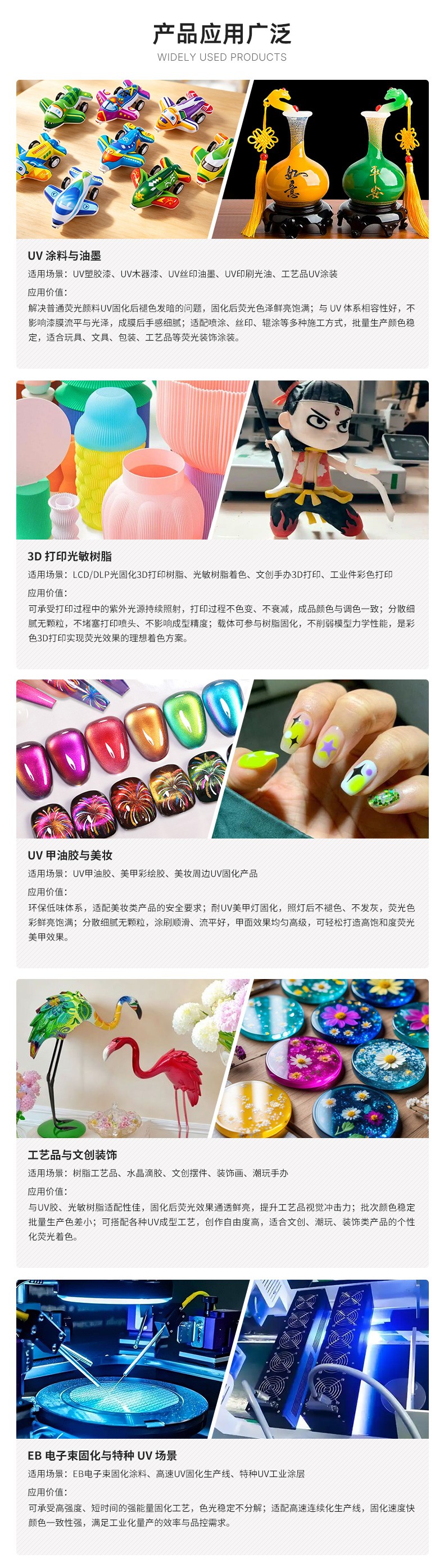
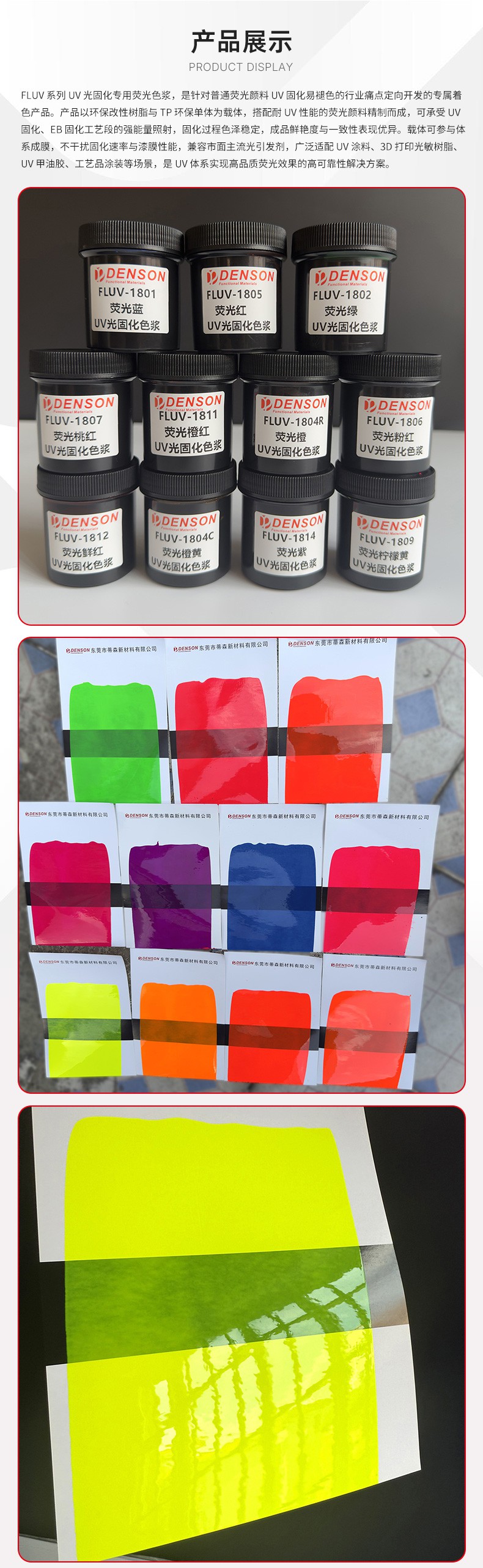
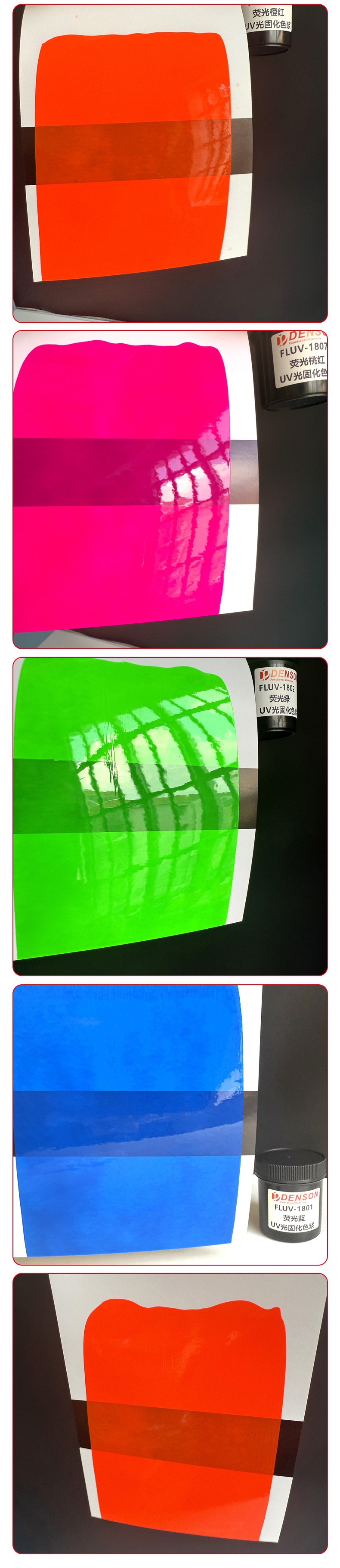
Solution Recommendation:DENSON FLU UV‑curable color pastes DENSON FLU series UV color pastes are specifically developed for 100%‑solid UV/LED‑curing systems. The pigment is well dispersed in UV oligomer / reactive diluent carrier without extra solvent. This product features good compatibility with acrylate‑based UV resins, low interference on curing response, stable tinting strength, excellent anti‑flocculation performance, and can be directly blended into UV base varnishes for color matching. It supports applications for wood coating, plastic decoration, electronics conformal coating and UV ink scenarios, helping formulators reduce trial‑and‑error cycles in color‑coating R&D.
Note: The end‑user still needs to re‑verify curing energy, maximum addition dosage and film‑forming performance according to actual resin system and production process.
Core technical challenges of UV‑curable coatings mainly originate from free‑radical polymerization mechanism, light‑energy matching, raw‑material property and production‑process constraints. Formulators should comprehensively optimize resin‑monomer‑photoinitiator‑additive‑colorant system. For colored UV projects, selecting professional UV‑specific color pastes such as DENSON FLU series can effectively mitigate common color‑related defects and accelerate product development iteration.


Mr. Jia: 159-1691-0100 13360650502 Mr. Jiang:13924940045
Email:denson168@163.com
Address: Room 101, No. 1, Lane 11, Changsheng Street, Dalian Tang, Wanjiang Street, Dongguan City, Guangdong Province

备案号:粤ICP备19036602号 粤公网安备 44190002005999号 Copyright Dongguan DENSON New Materials Co., Ltd
